
Company Profile Design Kenya: What Tender Boards, Banks, and Donors Actually Want to See
If you have ever submitted a tender to a county government office in Nairobi, Mombasa, or Kisumu and been disqualified on a technicality, you already know that a company profile in Kenya is not a brochure. It is a compliance document, a sales document, and a trust document at the same time — and most templates downloaded from Canva or copied from a Nigerian or South African website fail at all three.
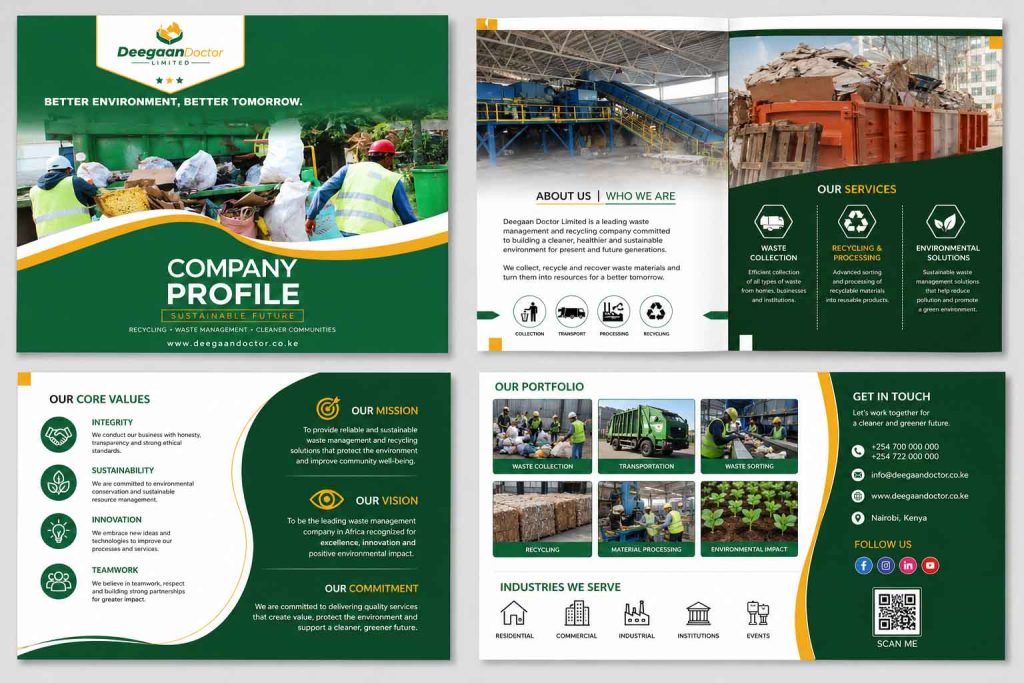
At Kenya Company Profile Designers (KCPD), we build company profile designs specifically for the Kenyan procurement and business environment: documents that match what the Public Procurement Regulatory Authority (PPRA) expects, what AGPO evaluators check for, what relationship managers at KCB, Equity, Co-op Bank, and NCBA scan for during loan appraisals, and what donor compliance officers at USAID, GIZ, or the EU delegation in Kenya flag during due diligence.
Why a Generic Template Gets Your Bid Rejected in Kenya
Kenyan procurement evaluation is line-item based. A typical county tender evaluation sheet will award or deduct points for specific, named items: registered company name matching the Certificate of Incorporation exactly, KRA PIN certificate reference, valid Tax Compliance Certificate status, CR12 details matching the listed directors, and physical office location within the specified sub-county where required.
A generic company profile design pulled from a template marketplace almost never includes a structured compliance page, because templates are built for a global audience that has never seen a CR12 or an AGPO certificate. When evaluators cannot locate this information within the first few pages, scoring sheets in Kenya commonly assign a zero on that line — regardless of how strong the rest of the bid is. This is the single most common, and most preventable, reason solid Kenyan SMEs lose tenders they were technically qualified to win.
What a Professional Company Profile Design in Kenya Must Contain
A profile written for the Kenyan market needs to satisfy three different readers — a procurement officer, a credit analyst, and a potential client — often within the same document. The structure we use at KCPD reflects that reality rather than a generic “About Us, Services, Why Choose Us, Contact” formula.
1. Statutory and registration block (page 1 or 2, not buried at the back) This includes the registered business name as it appears on the Certificate of Incorporation from the Business Registration Service (BRS), the company registration number, KRA PIN, VAT status if applicable, and AGPO certificate number for businesses registered under the Access to Government Procurement Opportunities programme for youth, women, and persons with disabilities. Evaluators look for this within seconds; it should not require searching.
2. Directorship and shareholding clarity Kenyan banks and donor agencies cross-check the names listed in a profile against the CR12 filed at the Companies Registry. A mismatch — even a misspelled director’s name — can trigger a compliance flag during a loan or grant review. We pull this information directly from current statutory filings rather than from whatever was typed into the original founding documents years ago.
3. Project and works history formatted for evaluation scoring Most Kenyan tender documents score “relevant experience” using a table: client name, contract value, period of performance, and a reference contact who can be called to verify the work. A narrative paragraph describing “our extensive experience” does not score points on a structured evaluation sheet. We format track record as verifiable, callable references because that is literally how marks are awarded.
4. County and sector-specific context A profile for a construction firm bidding on a Nairobi County road maintenance tender needs NCA (National Construction Authority) registration class displayed prominently. A profile for an agribusiness pursuing AFA or KEPHIS-regulated contracts needs different compliance markers entirely. A one-size profile cannot serve a fintech startup applying for a Central Bank of Kenya sandbox slot and a borehole drilling contractor bidding for a Water Resources Authority tender — yet most “professional company profile design Kenya” services online sell exactly that single template to everyone.
How KCPD Approaches Corporate Profile Design Differently
Rather than starting from a design template, our process starts with a document audit of what the client is actually trying to unlock — a specific tender, a bank facility, a donor partnership, or investor due diligence — because each of those readers scores a document differently.
For a business profile aimed at AGPO tenders, we structure the document around the PPRA evaluation criteria itself, so the scoring committee finds compliance information in the order their checklist expects it.
For a corporate profile aimed at bank lending (working capital loans, asset finance, or LPO financing common among Kenyan SMEs), we build a financial capacity section that mirrors what credit committees actually request: three years of summarized turnover trend, existing banking relationships, and collateral or security context — information a generic “Why Choose Us” page never addresses.
For NGOs and social enterprises seeking donor partnerships, we structure the profile around due diligence frameworks donors commonly request, including governance structure, safeguarding policy reference, and audited financial statement availability, since these are what compliance officers actually check before releasing funds.
Industries Where Profile Design Mistakes Cost the Most in Kenya
Construction and engineering firms lose the most value to weak profiles because NCA registration class, past works value bands, and equipment lists are heavily weighted in scoring — yet are frequently left out entirely in template-based designs.
SACCOs and microfinance institutions face a different problem: regulatory trust. A profile that does not clearly reference SASRA registration status (for deposit-taking SACCOs) reads as incomplete to a partner bank or investor, regardless of actual compliance.
Security firms bidding for institutional contracts need PSIRA licensing details positioned where procurement officers expect statutory information, not buried in a footer.
Agribusiness exporters pursuing EU or Gulf buyers need traceability and certification references (KEPHIS, HCD, Global GAP where applicable) because international buyers’ due diligence teams specifically search for these terms.
A Realistic Document Checklist We Use Before Design Begins
Before any layout work starts, we collect:
- Certificate of Incorporation and CR12 (current, not founding-year version)
- KRA PIN certificate and current Tax Compliance Certificate
- AGPO certificate, NCA certificate, PSIRA license, or sector-specific registration, where applicable
- A list of completed contracts with client contact details that can be verified
- Three years of summarized financial performance, if the profile targets bank or donor review
This is not paperwork for its own sake. Each of these documents maps directly to a line item on a Kenyan evaluation sheet, loan appraisal form, or donor due diligence checklist, and skipping the audit stage is exactly how generic, low-scoring profiles get produced in the first place.
Pricing Context for Company Profile Designs in Kenya
Pricing for company profile design Kenya-wide varies mainly by document depth, not page count. A 6-page profile built for a small business pursuing local tenders requires far less compliance mapping than a 20-page corporate profile built for an organization pursuing a USAID implementing-partner role, which involves governance, safeguarding, and financial-management sections reviewed by a separate compliance unit. We scope each project against the specific reader it needs to convince rather than quoting a flat per-page rate that ignores what the document is actually for.
Frequently Asked Questions
Does a company profile need to match the CR12 exactly? Yes. Tender evaluators, banks, and donor compliance teams in Kenya routinely cross-reference director names and shareholding listed in a profile against the CR12 on file at the Companies Registry. Any mismatch can delay or disqualify an application.
Is AGPO certification information required in every business profile? Only for businesses registered under the AGPO programme and bidding for the 30% government set-aside. Including it where applicable improves scoring; omitting it where required results in automatic point loss on most county evaluation sheets.
How is a corporate profile for a bank loan different from one for a tender? A bank-focused profile emphasizes financial capacity, turnover trend, and existing credit relationships. A tender-focused profile emphasizes statutory compliance and verifiable project history. Using one document for both purposes typically underperforms for at least one of the two readers.
Can an existing company profile be updated rather than redesigned from scratch? Yes, where the underlying statutory information is current. We frequently update directorship, compliance certificates, and project history on existing profiles rather than rebuilding the entire layout.
Kenya Company Profile Designers (KCPD) builds company profile designs, corporate profiles, and business profiles structured around how Kenyan tender boards, banks, and donor agencies actually evaluate documents. [Contact us] to start with a document audit before any design work begins.