

Company Profile Designers Kenya — Professional Company Profile Design Services by KCPD


Nairobi’s boardrooms, tender offices, and investor meetings run on paper — or more precisely, on the twelve to twenty pages that decide whether a company gets shortlisted, funded, or forgotten. Kenya Company Profile Designers (KCPD) builds those pages for a living.
We design company profiles for startups pitching their first client, SACCOs applying for regulatory recognition, construction firms bidding on county tenders, and NGOs courting donors who read fifty proposals a week and remember maybe three.
If you searched for company profile designers in Kenya, you’re likely holding one of three problems: you don’t have a profile yet and a client or tender deadline is approaching, you have one but it looks like it was made in 2014, or you tried to build one yourself and it reads more like a CV than a business case. KCPD solves all three, and this page explains exactly how.
Why Businesses Choose KCPD
Nairobi has no shortage of graphic designers who’ll slap a logo on a Word template and call it a company profile. KCPD is different in three measurable ways.
We understand procurement, not just design. Government suppliers and businesses applying for tenders need profiles structured around what evaluators actually score — company registration details, past performance, technical capacity, key personnel, and compliance documents.
A profile that looks beautiful but omits these sections gets marked down regardless of how clean the typography is.
We write as much as we design. Most clients arrive with scattered information — a few paragraphs from the founder, an old brochure, maybe a mission statement nobody agrees on anymore.
Our team restructures that raw material into a narrative that a stranger can read in four minutes and understand exactly what your company does, who it has worked with, and why it’s credible.
We build for two formats from day one. Every profile we design ships as both a print-ready PDF and a digital, editable version, because a construction firm submitting a hard-copy tender bid and an NGO emailing a donor have completely different delivery needs — often for the same document.
Client Type
Government supplier
Startup seeking investment
NGO
Manufacturer
School or hospital
Primary Use Case
Tender submissions
Investor meetings
Donor proposals
B2B sales
Parent/patient trust
What They Need Most
Compliance sections, past performance, registration details
Financial credibility, team bios, growth story
Impact data, transparency, program outcomes
Product catalogue, certifications, capacity statements
Accreditation, facilities, staff qualifications
Professional Company Profile Design Services
A company profile is the single most reused document in a business. It goes into tender bids, investor data rooms, bank loan applications, partnership proposals, and new client introductions — often the same week. KCPD’s core service covers the full lifecycle of that document:
- Content structuring — organizing your company’s information into a logical, persuasive sequence
- Copywriting and editing — rewriting rough notes into professional business language
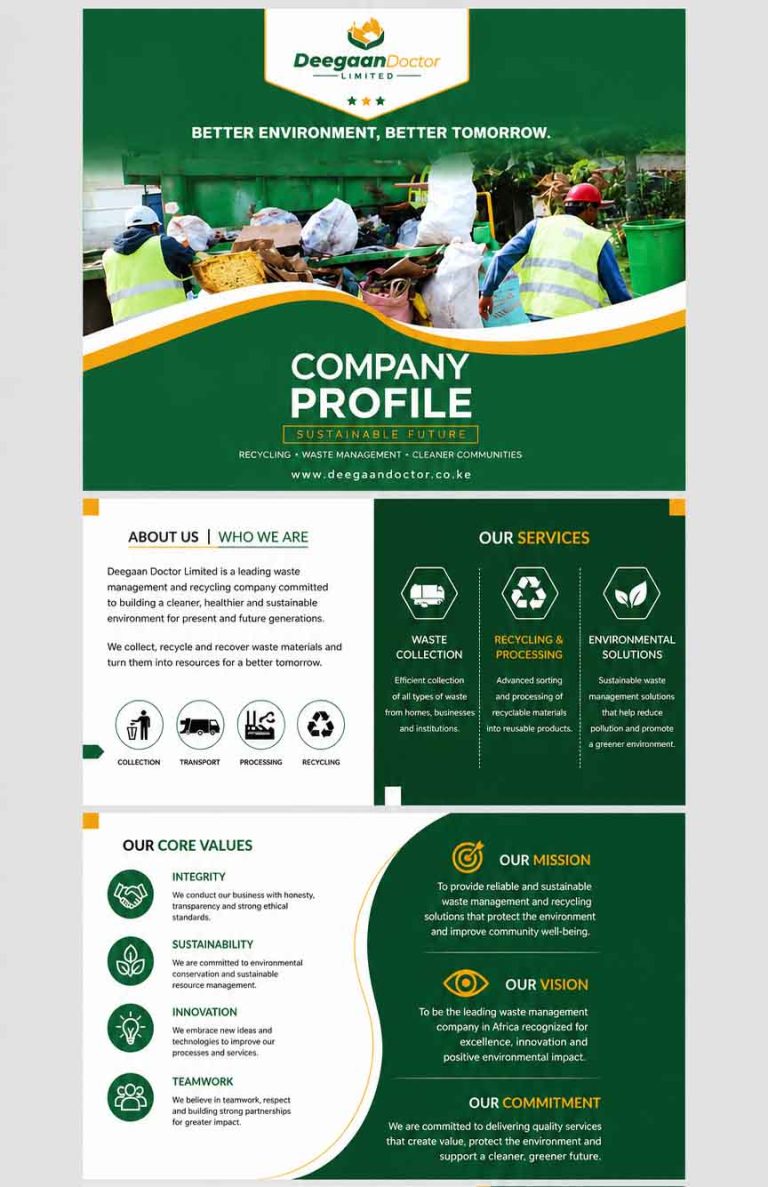
- Corporate profile design and layout — typography, colour systems, and visual hierarchy aligned to your brand
- Infographics and data visualization — turning statistics, timelines, and org charts into scannable visuals
- Print-ready and digital formatting — PDF, PowerPoint, and Word versions depending on your use case
- Revisions and version control — because your first profile is rarely your last; you’ll need updates as the company grows
We also handle related corporate branding work — logo refinement, letterheads, and presentation templates — so the profile isn’t a one-off document sitting apart from the rest of your identity.

Business Presentation Design That Works Alongside Your Profile
Many clients who come to us for a company profile also need a pitch deck for investor meetings or a capability statement for client presentations. We design these as a matched set, so your printed profile, your PDF version, and your slide deck all use the same visual language. A prospect who receives your profile on Monday and sees your deck on Wednesday should recognize your brand instantly, not wonder if they’re dealing with two different companies.
Industries We Serve
Kenya’s economy is not one market — it’s dozens of sub-markets with different documentation expectations, and we’ve designed profiles across most of them:
- Startups and SMEs building their first credible identity for banks, partners, and early clients
- Corporate companies refreshing outdated branding materials
- NGOs and civil society organizations preparing donor-facing proposals
- SACCOs meeting regulatory and membership communication needs
- Government suppliers compiling tender-compliant documentation
- Manufacturers showcasing production capacity and certifications
- Construction companies demonstrating project history and technical teams
- Logistics and transport companies presenting fleet capacity and route coverage
- Financial institutions communicating trust, licensing, and service scope
- Schools building enrollment-driving profiles for parents
- Hospitals and clinics presenting accreditation and specialist capacity
- Hotels and hospitality businesses showcasing facilities for corporate bookings
- Real estate companies presenting portfolios and development track records
- Consultants and professional service firms establishing individual or firm credibility
- Engineering firms documenting technical certifications and project delivery
- Importers and exporters demonstrating trade licensing and supply chain reliability
If your sector isn’t listed above, it’s very likely we’ve still worked with something adjacent to it — the underlying structure of a strong company profile changes less between industries than most people expect.
What does change, sector to sector, is which section of the profile carries the most weight. A logistics company’s readers care about fleet size and route coverage before they care about company history. A consultant’s readers care about individual credentials before anything else.
A real estate developer’s readers want to see completed projects on the very first spread, not buried on page nine. Part of what a good designer does — separate from layout and colour — is deciding what goes first, because most readers never make it past the first three pages.
Getting that sequence wrong is a far more common mistake than getting the visual design wrong, and it’s usually invisible to the client until a tender gets rejected or an investor stops responding.
Why Company Profiles Matter
A company profile answers one question before anyone reads a proposal, submits a tender bid, or opens a pitch meeting: can this company be trusted with the job?
Procurement officers reviewing tender submissions typically spend under two minutes deciding whether a bidder looks credible enough to keep reading. Investors reviewing a data room form an opinion of a founder’s professionalism from the first document they open, long before they get to the financials.
Donors evaluating an NGO proposal are, in practice, evaluating whether the organization can be trusted to spend money responsibly — and a scattered, inconsistent profile quietly signals that it can’t.
None of this is about aesthetics for their own sake. A well-designed profile works because it reduces the cognitive load on the reader.
It puts the right information in the expected place, in a sequence the reader already knows how to navigate, so they can make a judgment quickly instead of hunting for facts across five badly formatted pages.
There’s also a quieter, longer-term reason company profiles matter: they outlive the person who requested them. A tender officer moves departments. A founder pitches a second investor eighteen months after the first.
A new business development hire inherits a folder of client-facing documents and has to represent the company using whatever’s already there. In every one of these cases, the profile becomes the default explanation of the company when nobody who built it is in the room to add context verbally.
A profile that only makes sense with a verbal explanation attached hasn’t actually done its job — and that’s the gap most self-made or template-based profiles fall into.
It’s worth being specific about what “credible” looks like on paper, because it’s rarely about claiming to be the biggest or the best. Evaluators, investors, and donors read hundreds of profiles that all claim excellence.
What actually reads as credible is specificity — named clients instead of “various clients,” a dated project timeline instead of “years of experience,” a named accreditation body instead of “fully compliant.” Vague language is the single most common reason a well-designed profile still fails to convince anyone.
Benefits of a Professional Company Profile
It shortens your sales cycle. A prospect who receives a clear, well-organized profile needs fewer follow-up calls to understand what you do.
It strengthens tender submissions. Evaluators scoring bids against a checklist find compliance information faster in a properly structured profile, which reduces the risk of technical disqualification over a missing or buried section.
It builds investor confidence. A profile that presents your team, traction, and market position clearly signals operational maturity — something investors weigh almost as heavily as the numbers themselves.
It creates consistency across your business development team. When every salesperson, account manager, or business development officer sends the same polished profile, your company’s story stops depending on who happens to be writing the email that day.
It saves you from constant re-explaining. Instead of writing a fresh company description every time a new opportunity appears, you have a document that already does that work, ready to attach or adapt.
It supports every other corporate document you produce. Tender bids, loan applications, partnership MOUs, and donor proposals all draw from the same core information — a strong profile becomes the master reference for all of them.
It reduces the risk of disqualification on technicalities. Procurement evaluators work from checklists. A profile that’s missing a registration number, a tax compliance reference, or a required certification in the expected section can cost a bidder the entire contract, regardless of how strong the rest of the submission is. Getting the structure right the first time removes an entire category of avoidable losses.
It gives your company a document worth updating instead of rewriting. Businesses that treat their profile as a living document — reviewed and refreshed every year or two — spend far less time and money on it over a five-year period than businesses that rebuild from scratch every time an old, unmaintained version stops being usable.
Taken together, these aren’t marginal improvements. For a business that submits ten tenders a year, or an NGO writing eight donor proposals a quarter, a profile that measurably improves shortlisting rates pays for itself well before the end of the first year.
Our Design Process
Company profile design at KCPD follows a five-stage process built around one goal: getting from scattered information to a finished, professional document without endless back-and-forth.
Step 1 — Discovery and Information Gathering
We start with a structured questionnaire or a short call covering your company’s history, services, achievements, key personnel, and the primary purpose of the profile — tender submission, investor outreach, or general corporate use. This step exists because the biggest delay in most design projects isn’t design; it’s waiting on content.
Step 2 — Content Structuring and Copywriting
Our writers organize your raw information into a logical sequence and rewrite weak or overly technical language into clear business prose. If you don’t have existing content, we can build the first draft from the discovery call alone.
Step 3 — Design Concept Development
We produce an initial layout concept reflecting your brand colours, typography, and visual style, including cover design, section dividers, and any infographics needed for statistics, timelines, or organizational structure.
Step 4 — Review and Revisions
You review the draft and request changes. Most projects need one to two revision rounds to lock in wording, layout adjustments, and image placement.
Step 5 — Final Delivery
You receive the finished profile in print-ready PDF format and an editable source file, so future updates — a new client logo, an updated statistic, a new branch location — don’t require starting from scratch.
Typical turnaround: 3–10 working days for a standard profile, depending on content readiness and revision rounds. Rush delivery is available for urgent tender deadlines — ask when you request your quote.
The reason this process runs in five defined stages instead of an open-ended back-and-forth is simple: most delays in company profile projects come from unclear expectations, not from design work itself.
A client who knows exactly what they’ll review at each stage, and by when, tends to respond faster than one waiting for an undefined “draft” with no clear scope. That discipline is also why we can commit to realistic turnaround windows instead of the vague “a few weeks” estimate common among freelance designers juggling multiple unrelated projects at once.
Types of Company Profiles We Design
Not every company profile serves the same purpose, and treating them as interchangeable is one of the most common mistakes businesses make. Here’s how we approach each type.
Digital Company Profiles
Built for email attachments, website downloads, and screen viewing. These prioritize scannability — shorter blocks of text, clickable table of contents, and interactive elements like hyperlinked sections where appropriate.
A digital company profile in Kenya typically gets shared far more often than a printed one, simply because it moves through email and WhatsApp faster than paper does.
Print Company Profiles
Designed with print specifications in mind — bleed, CMYK colour accuracy, paper stock recommendations, and binding options (saddle-stitch, spiral, or perfect bound). Company profile printing in Kenya has its own quirks around paper availability and cost, and we advise on these during the design stage so the final print run doesn’t surprise you.
Tender Company Profiles
Structured specifically around procurement evaluation criteria: company registration and compliance documents, tax compliance references, past project performance, key personnel CVs, equipment and capacity statements, and financial capability summaries.
Tender company profile design in Kenya has to match the exact structure procurement officers expect, because a beautifully designed profile that’s missing a required compliance section can still cost a bidder the contract.
Investor Profiles
Built to answer the questions investors ask first: what problem you solve, market size, traction to date, team background, and what the funding will be used for. Investor profile design leans on data visualization — charts and growth curves rather than dense paragraphs — because investors read fast and skim for numbers.
Corporate Profiles
General-purpose profiles for established companies covering history, mission, services, leadership, and achievements. These serve as the master document that other, more specific profiles (tender, investor) often get adapted from.
NGO Profiles
Focused on mission, program areas, measurable impact, governance structure, and funding transparency. NGO profile design in Kenya requires particular care around presenting impact data honestly and clearly — donors are increasingly sophisticated about distinguishing genuine outcomes from vague claims.
Construction Company Profiles
Heavy on project portfolios — completed works, ongoing projects, equipment lists, and technical/engineering staff qualifications. Construction company profile design typically includes before/after project imagery and capacity statements county tender boards specifically request.
School Profiles
Built around what parents actually evaluate: academic performance, facilities, staff qualifications, extracurricular programs, and fee structure clarity. School profile design in Kenya works best when it balances warmth (photography, testimonials) with hard credibility markers (exam results, accreditation).
Hospital Profiles
Centered on specialist departments, accreditation, equipment, and staff qualifications. Hospital company profile design needs to convey competence without feeling cold — patients and partner institutions are both reading it, often for different reasons.
Manufacturing Profiles
Organized around production capacity, quality certifications, supply chain reliability, and product catalogues. Manufacturers exporting goods often need a profile that works equally well for a local distributor and an international buyer evaluating them for the first time.
What Goes Into Pricing
Company profile design prices in Kenya vary based on several factors, and any provider quoting a single flat number without asking about your project is likely offering a generic template rather than a custom document. The main pricing factors are:
- Page count — a 6-page startup profile costs less than a 24-page corporate profile with detailed project portfolios
- Content readiness — profiles requiring full copywriting from scratch take more time than those where you provide finished text
- Design complexity — infographics, custom illustrations, and data visualizations add development time
- Number of formats — print-ready PDF only versus print, digital, and editable source files
- Revision rounds — most packages include one to two rounds; additional rounds are typically billed separately
- Turnaround time — rush jobs for urgent tender deadlines carry a premium
We offer tiers ranging from affordable company profile design for startups and SMEs working with tighter budgets, to premium company profile design packages for corporate clients needing extensive content development, custom infographics, and multi-format delivery. Request a quote with your page count and purpose, and we’ll give you an accurate figure rather than a placeholder range.
A quick way to get a faster, more accurate quote: tell us the purpose of the profile (tender, investor, general corporate use), roughly how many pages you’re expecting, whether you already have written content or need it developed from scratch, and your target deadline. Those four details are usually enough for us to give a firm price within a day, rather than a broad range that leaves you no better informed than before you asked.
Professional Print and Digital Company Profile Solutions
Modern businesses require company profiles that perform exceptionally well across both print and digital platforms. Our company profile design services include professionally prepared print-ready files alongside optimized digital versions designed for easy sharing and online distribution.
For printed company profiles, we utilize industry-standard production specifications, including high-resolution graphics, professional formatting, CMYK color settings, and accurate print preparation to ensure exceptional quality and consistency. This guarantees that your profile maintains a polished and professional appearance when produced for meetings, exhibitions, conferences, proposals, and corporate presentations.
In addition, our digital company profile solutions are optimized for websites, email distribution, online presentations, downloadable PDFs, and electronic marketing campaigns. Every profile is designed to maintain visual excellence while offering a seamless viewing experience across multiple devices and platforms.
This comprehensive approach ensures your investment delivers long-term value across a wide range of business applications. Whether you are presenting to investors, submitting tenders, meeting prospective clients, or promoting your business online, your company profile remains professional, impactful, and easy to access.
As some of the best company profile designers Kenya businesses trust, we create versatile corporate profiles that strengthen brand credibility, improve communication, and help organizations stand out in increasingly competitive markets.
Why Choose KCPD Over Other Designers
Factor
Custom content writing
Tender-compliant structuring
Print + digital delivery
Industry-specific structure
Editable source files
Revision support
Generic Freelancer
Rarely included
Depends on individual
Sometimes
Generic
Not always
Limited
Template Marketplace
Not included
No
Digital only, usually
Generic
Rarely
None
KCPD
Included
Yes
Both, as standard
Tailored per sector
Always provided
Included in every package
Beyond the comparison, three things consistently bring clients back to KCPD for repeat work: we meet deadlines that matter for tender submissions, we keep source files organized so a profile update six months later doesn’t mean starting over, and we ask enough questions upfront that the first draft is usually close to final — not a rough guess that needs a complete rebuild.
None of this replaces seeing actual work. Before committing to any designer, ask to see finished profiles from businesses in a similar sector to yours — not just a generic portfolio grid. A tender-focused profile for a construction firm and an investor profile for a fintech startup are built to completely different specifications, and a portfolio that only shows one type tells you very little about whether that designer can handle the other.
Frequently Asked Questions
What is a company profile and why does my business need one?
A company profile is a document — typically 5 to 30 pages — that presents your company’s history, services, team, and achievements in a structured format. Businesses need one for tenders, investor meetings, client introductions, loan applications, and partnership proposals.
A company profile is a document — typically 5 to 30 pages — that presents your company’s history, services, team, and achievements in a structured format. Businesses need one for tenders, investor meetings, client introductions, loan applications, and partnership proposals.
How much does company profile design cost in Kenya?
Pricing depends on page count, content readiness, and design complexity. Startup profiles with minimal pages cost less than corporate profiles requiring custom infographics and full copywriting. Request a quote for an accurate figure based on your specific requirements.
How long does it take to design a company profile?
Standard turnaround is 5 to 10 working days, depending on how quickly content and feedback are provided. Rush delivery is available for urgent tender deadlines.
Can KCPD write the content for my company profile, or do I need to provide it?
Either works. If you provide raw notes, achievements, and background information, our writers structure and polish it into professional copy. If you have no content at all, we can build a first draft from a discovery call.
Do you design company profiles for tenders specifically?
Yes. Tender company profiles are structured around procurement evaluation criteria, including compliance documents, past performance records, and key personnel details, so bidders don’t lose points over missing or buried sections.
What's the difference between a company profile and a brochure?
A brochure is typically shorter and marketing-focused, aimed at prospective customers. A company profile is more comprehensive, covering governance, capacity, and credibility information used for formal purposes like tenders, investment, and partnerships.
Do you provide both print and digital versions?
Yes, every profile we design is delivered as a print-ready PDF and a digital version suitable for email and website use, with an editable source file included.
Can you redesign an existing outdated company profile?
Yes. Many clients come to us with an old profile that no longer reflects their branding, services, or achievements. We can rebuild it from scratch or refresh the existing structure and content.
Do you design company profiles for NGOs and SACCOs?
Yes. NGO profiles are built around mission, program impact, and donor transparency, while SACCO profiles focus on membership benefits, governance, and regulatory compliance.
What information do I need to prepare before starting?
Company registration details, a description of your services or products, key personnel bios, past project or client examples, and any existing branding materials (logo, colours). We’ll guide you through gathering the rest during discovery.
Can a company profile help with investor fundraising?
Yes. Investor-focused profiles present traction, team credibility, and market opportunity in a format investors are accustomed to reviewing quickly, which supports (though doesn’t replace) a full pitch deck.
Do you offer company profile printing services in Kenya?
We prepare print-ready files with correct specifications for local printers, and can recommend printing partners or coordinate printing directly, depending on your preference.
How many pages should a company profile have?
Startup and SME profiles typically run 6 to 12 pages. Corporate and tender profiles with detailed project portfolios often run 15 to 30 pages. The right length depends on your industry and purpose, not a fixed rule.
Can you design a company profile for a school or hospital?
Yes. School profiles emphasize academic performance, facilities, and staff qualifications for parents, while hospital profiles highlight specialist departments, accreditation, and equipment for patients and partner institutions.
Is an editable company profile file included?
Yes. Every project includes an editable source file so future updates — new statistics, new clients, a new branch — can be made without redesigning from scratch.
What formats do you deliver the final company profile in?
Standard delivery includes a print-ready PDF, a web-optimized PDF, and an editable source file (typically InDesign, PowerPoint, or Word, depending on the project).
Do you offer rush company profile design for urgent tender deadlines?
Yes, subject to availability. Let us know your deadline when requesting a quote so we can confirm turnaround feasibility.
Can you match the company profile to our existing brand guidelines?
Yes. If you have brand guidelines — colours, fonts, logo usage rules — we design within them. If you don’t have formal guidelines yet, we can establish a consistent visual system as part of the project.
How many revisions are included?
Most packages include one to two rounds of revisions. Additional rounds can be added if needed.
Do you serve businesses outside Nairobi?
Yes. While we’re based in Nairobi, we work with clients across Kenya remotely, coordinating content review and file delivery digitally.
What makes a company profile stand out to procurement officers or investors?
Clear structure, relevant evidence (past performance, financials, credentials) presented where evaluators expect to find it, and language that’s confident without being vague. Design quality matters, but it supports credibility rather than replacing substantiated content.
Can KCPD also design our logo or broader corporate branding alongside the profile?
Yes. We handle related corporate branding work including logo refinement, letterheads, and presentation templates, so your profile aligns with the rest of your visual identity.